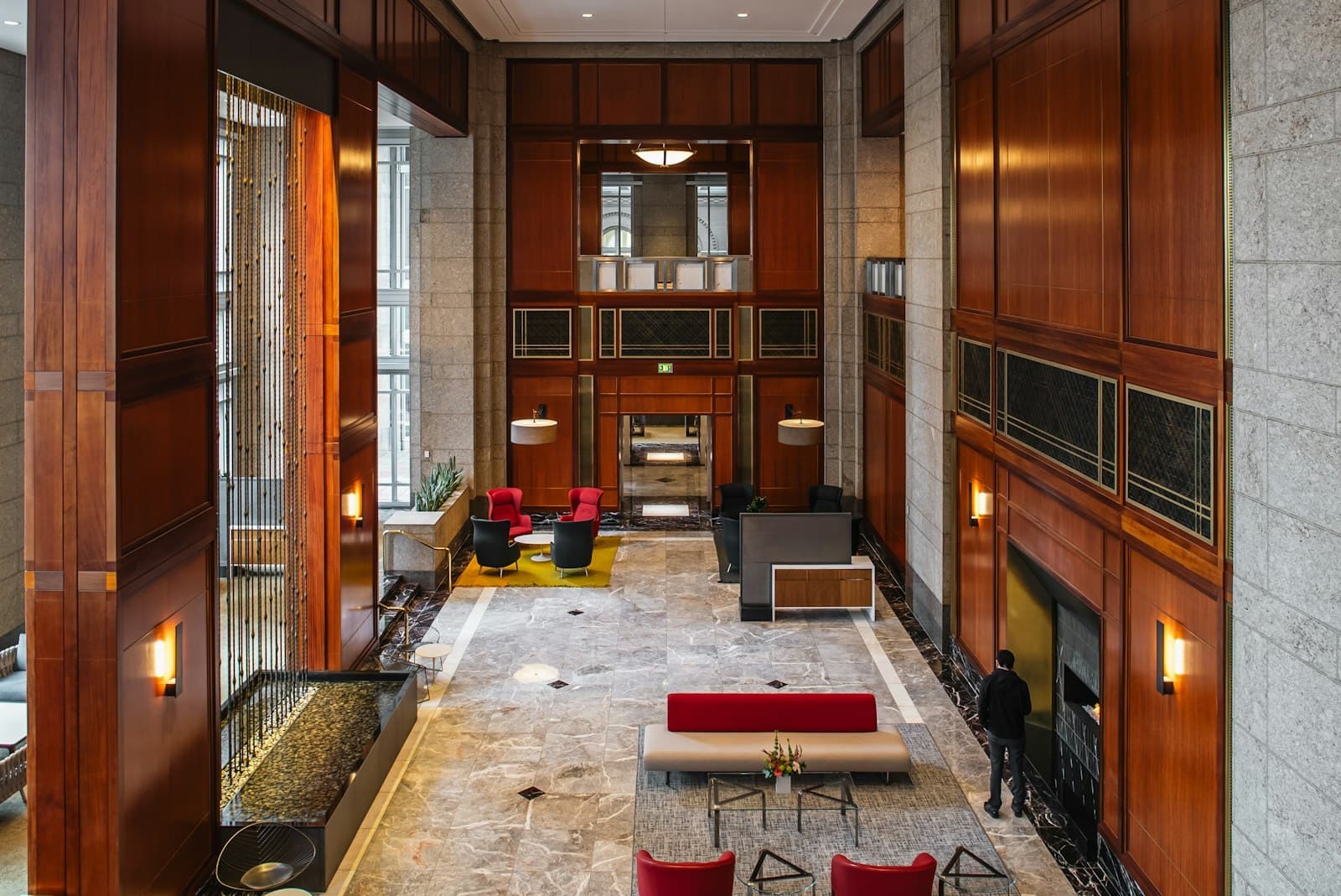
SECTOR FOCUS — COMMERCIAL / CORPORATE INTERIORS & HIGH-RISE
A fit-out is one floor's problem. A tower goes up one hoist trip at a time.
We track both halves of this market closely — a corporate interior fit-out and a high-rise tower are different construction problems that happen to share a label.
This page reflects general industry practice and BuildIQ Advisors' professional perspective as of publication. It is not tailored to any specific project, does not constitute engagement-specific advice, and does not create an advisory relationship. Verify current codes, standards, and site-specific conditions independently before acting.
CURRENT CHALLENGES
Corporate interiors — office-to-residential conversion is the dominant current story.
Office-to-apartment conversions reached 90,300 units at the start of 2026, a 28% year-over-year jump and a 291% increase since 2022 — office conversions now account for 47% of all future adaptive-reuse projects nationally, led by New York, with Chicago, Los Angeles, and Dallas rounding out the top five markets. The construction challenge is real and building-specific: converting floor plates laid out for offices into residential units where natural light is critical, adding plumbing risers, reconfiguring elevator banks for residential circulation, and retrofitting HVAC zoning never designed for individual dwelling units.[1]
High-rise and vertical construction — vertical transport is the structural bottleneck.
2026 high-rise construction costs run $250–$700/SF, with a 1.32% Q1 2026 cost increase driven partly by high-growth sectors pulling on the same materials pool. The binding physical constraint is limited tower-crane and hoist capacity: crews and heavy equipment have to be transported up and down the tower daily. Separately, permanent elevator installation itself takes 4–12 weeks for residential and 8–20 weeks for commercial builds depending on hoistway readiness and code review — high-speed units for true skyscraper travel can exceed $300,000 per unit. Specialty labor — certified high-elevation glazing installers, certified tower-crane operators — commands a premium, and insurance and safety costs for high-rise crews run materially above a standard suburban jobsite.[2][3][4]
WHAT SHOULD BE CONSIDERED TO OVERCOME THEM
HOW IT'S ACTUALLY GETTING BUILT
Office-to-residential conversion of the right stock
Proven and accelerating fast — only for a specific subset of buildings
Narrow floor plates, operable window and HVAC systems. The tradeoff: a building bought for conversion economics that turns out not to have those characteristics becomes a far more expensive retrofit than assumed, sometimes uneconomical after acquisition — the due-diligence window before purchase is the only point where this is cheap to discover.
Dedicated vertical-transport scheduling
Proven, standard practice on real high-rise jobs
24/7 or night-shift crew and material hoisting plans to keep a tall tower's daily productivity from bottlenecking at the elevator or hoist. The tradeoff: shift scheduling buys productivity at the cost of overtime and shift-differential labor premiums and materially more complex safety and coordination overhead.
Early elevator award and long-lead procurement
Proven and standard on any serious high-rise
Locking in the elevator contract well before design is fully resolved — the same pattern seen in long-lead electrical equipment elsewhere. The tradeoff: it locks hoistway dimensions and travel specs early, constraining later architectural changes to the building core. What's genuinely unsettled: whether office-to-residential conversion economics stay favorable if office vacancy stabilizes or improves — much of the current advantage comes from a historically cheap acquisition basis on distressed office stock, and that advantage narrows or disappears if the office market recovers.
WHAT WE WOULD HELP THEM NAVIGATE
- For a conversion: verifying plumbing riser locations, elevator bank reconfiguration feasibility, and floor-plate daylight access before the acquisition closes — these are largely undoable cheaply once the building is bought, and the due-diligence window is the only cheap point to find out.
- For a high-rise: confirming the elevator's actual confirmed delivery and installation slot — not the quoted lead time — is reflected in the tower's critical path, and that the daily vertical-transport bottleneck for crews and materials is planned for, not assumed away.
- For a corporate tenant fit-out: flagging how much of the cost swing driven by landlord-delivered shell condition has actually been accounted for in the budget, before the lease is signed.
- Verifying specialty labor — high-elevation glazing crews, certified crane operators — is committed under contract for this specific tower, not assumed available in the regional market.
Direct delivery experience runs both halves of this sector. On the interiors side, a corporate construction division was built into a $30 million annual business, managing 15–20 commercial interior and fit-out projects a year for corporate owners and tenants, including individual fit-outs ranging from $1.1 million to $3.0 million. On the vertical and high-rise side, experience includes large-scale institutional construction with complex MEP, advanced security, and secure-detention systems, alongside two senior high-rise renovations — a 181-unit, 20-story building and a 450-unit occupied building — representing complete gut rehabilitation and life-safety/riser replacement at true high-rise scale.
WEEK-ONE QUESTIONS
WEEK ONE — WHAT WE'D ASK ON A PROGRAM LIKE THIS
- 01
If this is a conversion, has plumbing riser location, elevator bank capacity, and floor-plate daylight access been hard-verified before acquisition closes, or is conversion feasibility still assumed?
- 02
What is the confirmed elevator delivery and installation slot, and does the tower's critical path actually reflect it rather than the quoted lead time?
- 03
What is the vertical-transport plan for crews and materials during peak trade stacking, and has anyone modeled the productivity hit if that plan doesn't hold?
- 04
For a corporate fit-out, what is the landlord-delivered shell condition, and how much of the resulting cost swing has been budgeted?
- 05
Is the specialty labor for this specific tower — high-elevation glazing, certified crane operators — committed under contract, or assumed available in the regional market?
Professional Services Disclosure
BuildIQ Advisors provides construction advisory and consulting services under signed engagement agreements, performed to the standard of care customary for the industry. We are not a licensed architecture, engineering, accounting, or law firm — advice requiring those licenses should come from one. Engagement terms govern each project.