SECTOR FOCUS — HIGHER EDUCATION
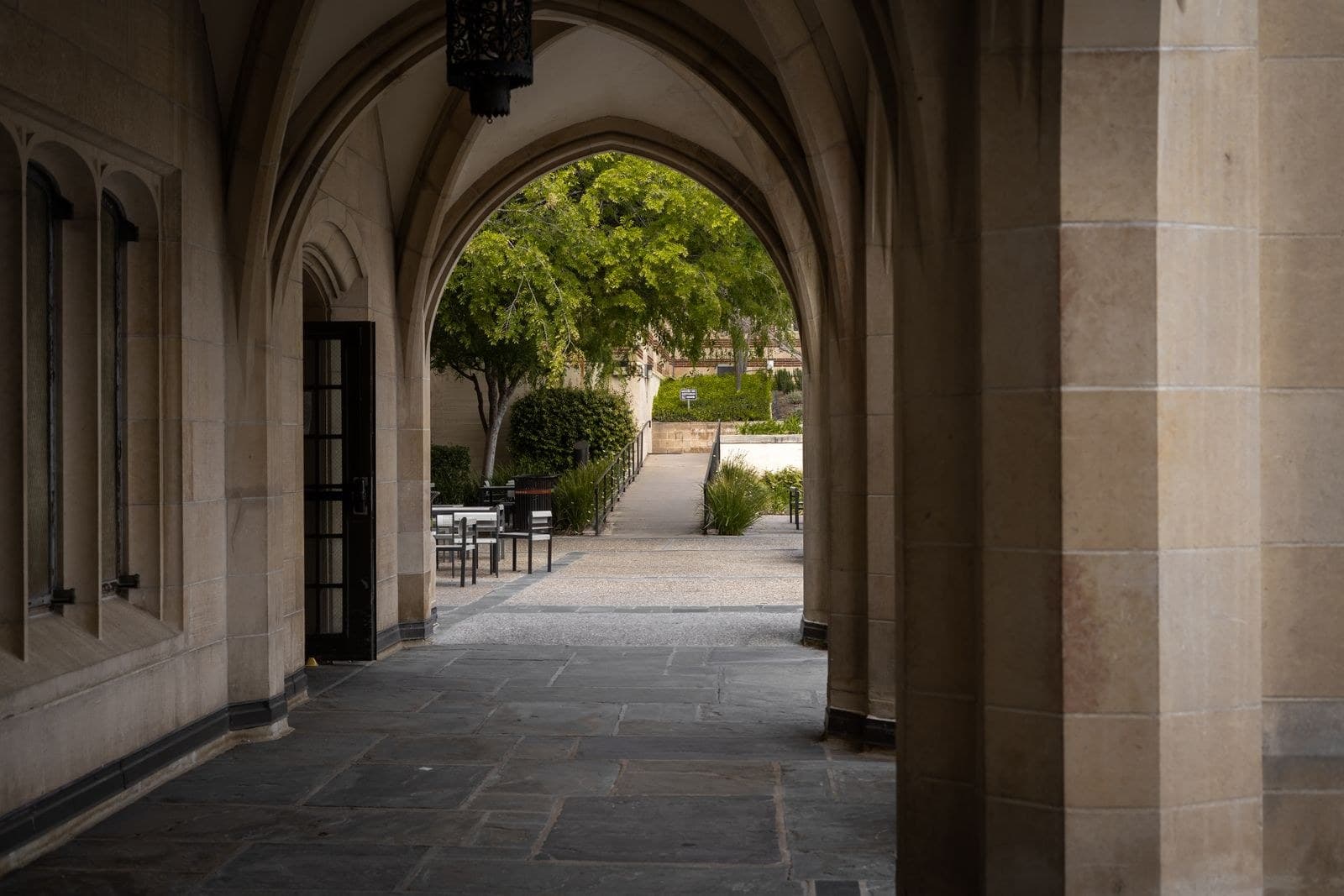
The buildings are 53 years old. The enrollment is shrinking.
We track this market closely — a deferred-maintenance backlog and a demographic enrollment cliff are colliding at the same time, and that collision is reshaping how campuses build.
This page reflects general industry practice and BuildIQ Advisors' professional perspective as of publication. It is not tailored to any specific project, does not constitute engagement-specific advice, and does not create an advisory relationship. Verify current codes, standards, and site-specific conditions independently before acting.
CURRENT CHALLENGES
A $200 billion deferred-maintenance backlog is aging in place.
Higher education is carrying a $200 billion national deferred-maintenance backlog, growing by $15–20 billion every year — Moody's Ratings has separately flagged a nearly $1 trillion “hidden liability” in physical capital needs across colleges over the next decade. The average university facility is now 53 years old, meaning most major building systems — HVAC, roofing, electrical, plumbing — have exceeded their 25–30 year design life by two full decades.[1][2]
The enrollment cliff is compressing revenue at the same time expense is accelerating.
The 2026 enrollment cliff — driven by the post-2008 birth-rate decline — means the traditional-age college population is shrinking for the first time in decades, compressing tuition revenue at the exact moment deferred-maintenance expense is accelerating. Moody's treats deferred-maintenance ratios as a negative credit indicator, and more than 100 colleges — concentrated among small private nonprofits with endowments under $100 million — are flagged as at risk of closure or merger. The direct construction-market effect: deferred maintenance, not new expansion, is now the primary driver of higher-ed construction activity, while mid-tier, tuition-dependent institutions delay or resize capital projects under margin pressure and enrollment volatility.[3]
Where institutions are still building, P3 structures are taking on more of the risk.
Student housing is increasingly delivered through public-private partnership structures rather than university-issued debt — Western Kentucky University's 2026 board-approved P3 with a private development partner for a new 1,000-bed housing and dining facility, and the University of Rhode Island's early-2026 groundbreaking under a similar model, are current, named examples.[4][5]
WHAT SHOULD BE CONSIDERED TO OVERCOME THEM
HOW IT'S ACTUALLY GETTING BUILT
Data-driven deferred-maintenance triage
Proven, standard practice — manages the rate of loss, not the underlying problem
Facility-condition-index-based prioritization for deciding what gets fixed now against a backlog that can't be fixed all at once. The tradeoff: a $15–20 billion annual backlog growth means fixing this year's worst building still leaves every other building a year older, and the backlog keeps compounding regardless of how well any single project is triaged.[7]
Consolidation and repurposing of underutilized space
Real and happening at some institutions — adoption is uneven
Right-sizes physical footprint to a declining-enrollment reality — as much a political and institutional decision as a facilities one. The tradeoff: consolidation avoids new-construction cost but carries real political and mission cost — alumni, donors, and faculty are frequently attached to specific facilities, and repurposing or closing a building can trigger institutional resistance regardless of how sound the underlying facilities logic is.
P3 student-housing structures
Proven and growing — Western Kentucky and University of Rhode Island are live, current examples
Shift financing, design, and construction risk to a private development partner while the university retains control over mission-driven priorities. The tradeoff: P3 structures move financing and construction risk off the university's books, but the university trades away direct control over the asset's long-term condition and business terms to a private partner across a ground lease that typically runs 30–40-plus years — a deal that looks favorable at signing can look very different decades later. What's genuinely unsettled: whether P3 structures actually save a university money over the full life of the deal once long-horizon ground-lease revenue-sharing and control costs are accounted for, versus traditional university-issued debt — a live, unresolved decision in current higher-ed facilities finance, not a settled answer either way.[6][8]
WHAT WE WOULD HELP THEM NAVIGATE
- Testing whether a specific capital project still makes sense against declining-enrollment revenue projections, rather than pre-cliff enrollment assumptions still embedded in an older capital plan.
- Flagging where deferred-maintenance triage is being driven by facility-condition data and life-safety risk versus institutional politics — which building has the most vocal advocate — before capital is committed to the wrong priority.
- For a P3 deal, stress-testing the 20–30-year financial and control exposure — not just the initial transaction terms — before the university signs a ground lease that will outlive most of the people negotiating it.
- Weighing the institutional and political cost of repurposing or consolidating existing underutilized space honestly against the construction cost of building new, rather than defaulting to new construction because it avoids a harder internal conversation.
- For a research or lab facility specifically, coordinating specialized equipment and infrastructure — fume hood and exhaust systems, vibration control, dedicated power — on its own procurement clock against the construction schedule, the same owner-furnished-equipment discipline that governs clinical equipment coordination in healthcare construction, applied to a research-lab context instead.
WEEK-ONE QUESTIONS
WEEK ONE — WHAT WE'D ASK ON A PROGRAM LIKE THIS
- 01
What is this institution's actual deferred-maintenance backlog and facility-condition index, and is the current capital plan prioritized by data — condition, life-safety risk — or by institutional politics?
- 02
Given the enrollment cliff, has the institution modeled whether this specific project still makes sense against a declining-enrollment revenue base, or is the plan built on pre-cliff assumptions?
- 03
If this is a P3, what happens to the university's control and financial exposure 20–30 years into the ground lease — has that long-horizon scenario actually been modeled, not just the initial deal terms?
- 04
Is repurposing or consolidating existing underutilized space on the table as an alternative to new construction, and has that institutional/political cost been weighed honestly against the cost of building new?
- 05
For a research or lab facility, what specialized infrastructure is being coordinated on its own procurement clock, separate from and synchronized with the general construction schedule?
Professional Services Disclosure
BuildIQ Advisors provides construction advisory and consulting services under signed engagement agreements, performed to the standard of care customary for the industry. We are not a licensed architecture, engineering, accounting, or law firm — advice requiring those licenses should come from one. Engagement terms govern each project.